
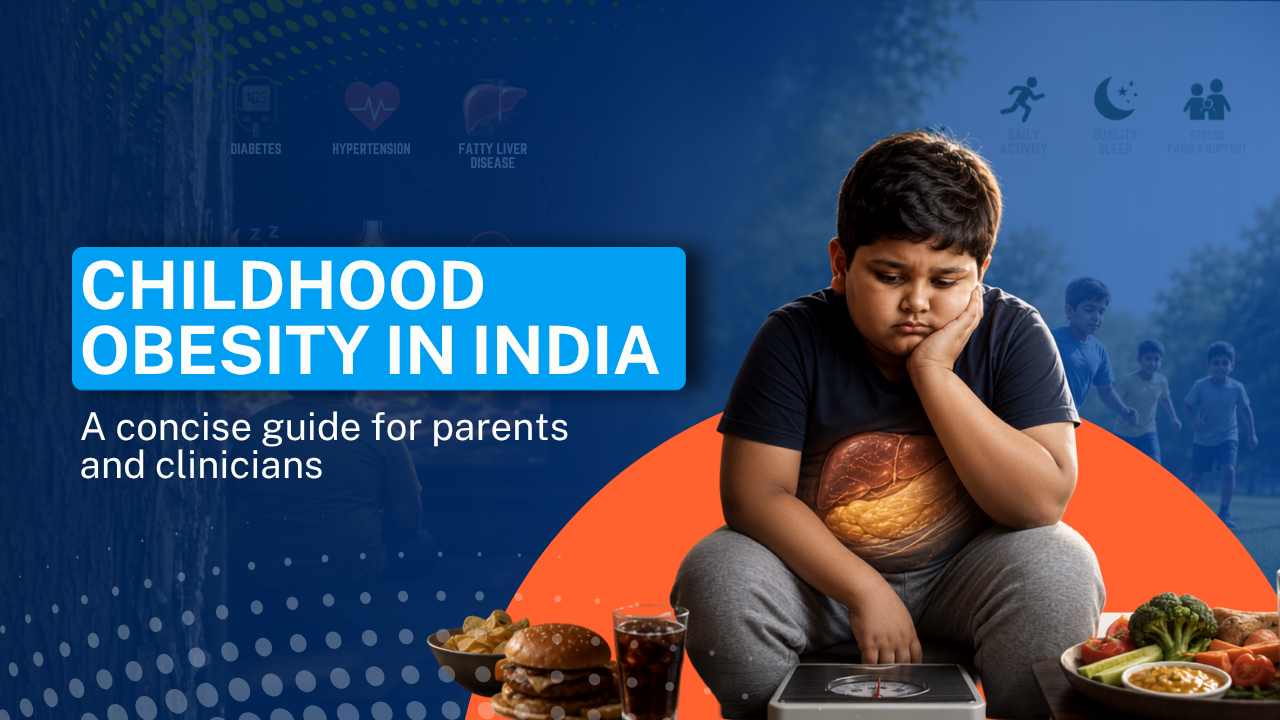
According to National Family Health Survey (NHFS) 4 & 5, there was a 60% surge in overweight children under 5 years of age (2016-2021). The latest report shows an improvement in this age category but India still ranks second in childhood obesity rates as per the World Obesity Federation Atlas 2026.
Childhood obesity is rising in India and carries early risks for diabetes, hypertension (BP), fatty liver, disease, sleep apnea and mental health problems; the Indian Academy of Pediatrics (IAP) revised guideline (2023) is the latest national framework for evaluation and management.
Definitions and screening
- Under 5 years: WHO weight‑for‑length/height charts; overweight ≥+2 SD, obesity ≥+3 SD.
- 5-18 years:
IAP category | Cutoffs |
Normal weight | BMI below the IAP overweight cutoff |
Overweight | BMI at or above the line corresponding to adult BMI 23 kg/m² |
Obesity | BMI at or above the line corresponding to adult BMI 27 kg/m² |
- Additionally monitor waist measures or waist‑to‑height ratio (WHtR) — WHtR ≈0.5 identifies central adiposity and cardiometabolic risk in Indian children.
- Screen body mass index (BMI) and BP at least annually; obese children ≥10 years (or younger with risk factors) need baseline labs (fasting glucose, lipid profile, liver enzymes).
Prevention
- Support exclusive breastfeeding for 6 months and continued breastfeeding with appropriate complementary foods.
- Establish regular meals, family meals at the table, and discourage grazing and night‑time snacking from early childhood.
- Limit screen time and energy‑dense, nutrient‑poor snacks at home.
- Implement school‑based child obesity prevention interventions (healthier school meals, nutrition and physical education).
Causes
- Most cases are primary, lifestyle related obesity from carbohydrate dense diets, low physical activity, more screen time, and urbanisation.
- Secondary causes (endocrine/genetic/drug‑induced) are uncommon and suspected when short stature, poor linear growth, or developmental delay are present.
Key complications
- Fatty liver disease (NAFLD, now called MASLD) is now seen in a large proportion of overweight/obese children, so screening high‑risk children is important.
- Other early complications include dyslipidemia, impaired glucose tolerance/type 2 diabetes, hypertension, obstructive sleep apnea, PCOS (female adolescents), musculoskeletal problems, and psychosocial disorders.
Core management
Lifestyle is first‑line: family‑based behavioural programs targeting diet, activity, sleep, and screen habits are the cornerstone and must be continued long‑term.
- Diet: Reduce refined carbohydrates and sugar‑sweetened beverages, increase pulses, vegetables and adequate protein from culturally appropriate sources (dal, milk, eggs, paneer, soy).
Ketogenic or very‑low‑carbohydrate diets may be considered and require monitoring. They should be considered only for adolescents (12–18 years) with severe obesity and significant comorbidities (for example, class 3 obesity or class 2 obesity with life‑threatening complications such as rapidly progressive NAFLD, poorly controlled type 2 diabetes) when intensive lifestyle therapy has failed and after informed discussion of risks and alternatives. Such diets must be delivered within a multidisciplinary programme (paediatrician/endocrinologist, registered dietitian, mental health and exercise professional).
Baseline assessment and ongoing monitoring should include height and height velocity, pubertal status, weight/BMI and body composition, blood pressure, fasting lipids, fasting glucose/insulin or HbA1c, liver and renal function tests, electrolytes, and key micronutrients (calcium, vitamin D, iron, B‑vitamins). Repeat clinical and laboratory review should occur frequently (eg, every 2–4 weeks initially, then at least monthly) with clear stop‑criteria for adverse effects, poor growth, or biochemical abnormalities. A predefined treatment duration, calculated transition plan back to a higher carbohydrate based diet and long‑term follow‑up for growth, bone health and cardiometabolic risk are essential components of safe K/LC use in adolescents.
- Physical activity: target ~60 minutes/day of moderate‑to‑vigorous activity for children, combining aerobic play and age‑appropriate resistance (body‑weight exercises) — adolescents may undertake supervised resistance training 2–3×/week to improve body composition and metabolic health.
- Sleep & screen time: ensure age‑appropriate sleep (school‑age ≈9–11 h; adolescents ≈8–10 h) and limit recreational screen time to <2 hours/day; remove screens from bedrooms and avoid screens during meals and before bed.
Monitoring and follow‑up (clinician checklist)
- At diagnosis: height, weight, BMI plotted on IAP charts, waist/WHtR, blood pressure, basic labs if indicated (fasting glucose, lipids, ALT). Repeat anthropometry and BP at regular intervals (3–6 months) and labs based on risk or abnormal results.
- For suspected secondary causes: refer for endocrine/genetic evaluation when red flags (short stature, poor height velocity, dysmorphism, early severe/sudden weight gain) are present.
Medical interventions
- Pharmacotherapy is reserved for selected adolescents with severe obesity and/or significant comorbidities after structured lifestyle intervention fails; options may include metformin, Orlistat, and in selected cases GLP-1 receptor agonists, all within specialist and multidisciplinary follow-up.
- Bariatric surgery is considered only for very severe adolescent obesity after failed intensive lifestyle/pharmacotherapy, when growth is complete.
Psychosocial care and counselling
- Assess mood, bullying, body image, disordered eating, involve mental health professionals when needed. Use non‑stigmatising language involving the whole family for behaviour change.
- Parent tips: reduce junk food exposure, set regular family meal and activity routines, be role models and praise effort rather than weight alone.
References
- Indian Academy of Pediatrics Revised Guidelines on Evaluation, Prevention and Management of Childhood Obesity. Indian Pediatr. 2023;60(12):1013–1031. ncbi.nlm.nih
- Management of Obesity and Its Complications in Children: Indian review/meta‑analysis and practice perspectives.ncbi.nlm.nih
- NAFLD and liver findings in overweight/obese Indian children.ncbi.nlm.nih
- IAP/IAP‑linked BMI chart background and Indian cutoffs (Khadilkar et al.) indianpediatrics
- Cucuzzella, M., Bailes, J., Favret, J.et al. Beyond Obesity and Overweight: the Clinical Assessment and Treatment of Excess Body Fat In Children. Curr Obes Rep 13, 286–294 (2024). https://doi.org/10.1007/s13679-024-00564-1